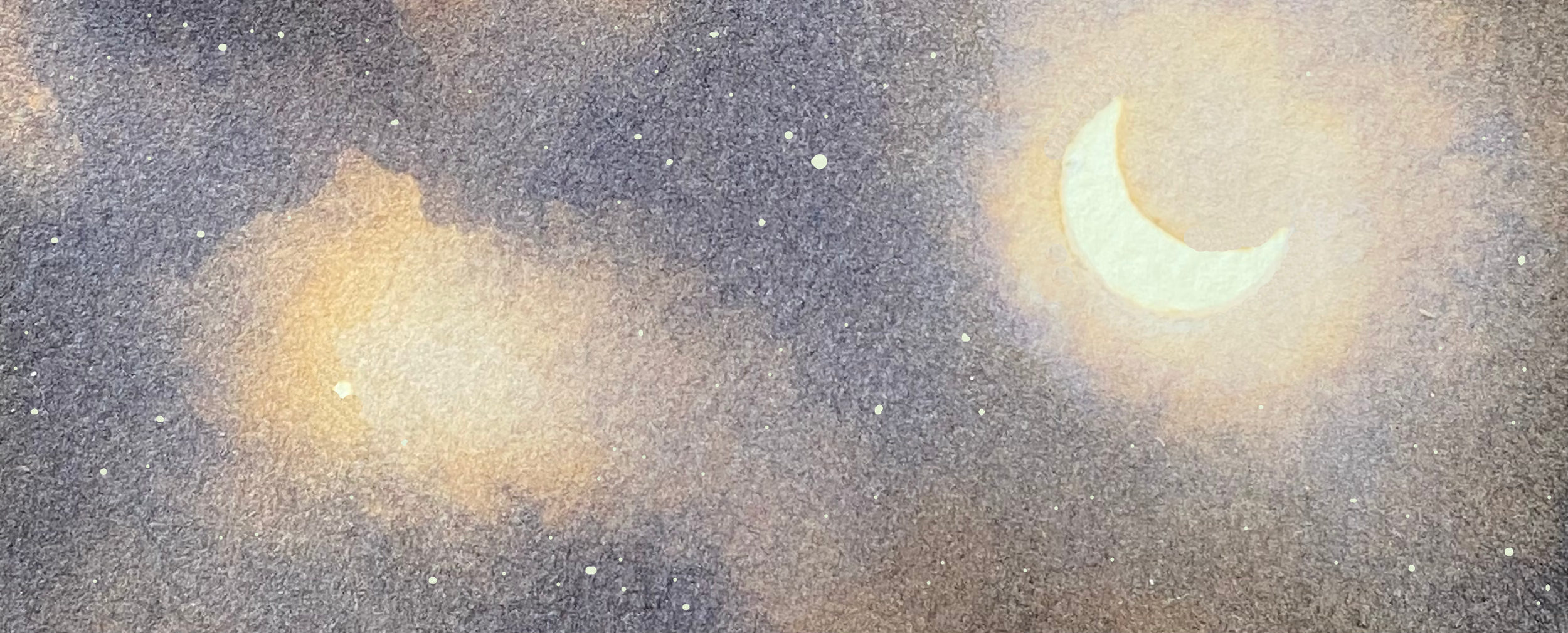
great spirit moon / moon after yule major goose moon / late yule moon
Hello All,
When I started doing this calendar a couple of years ago I decided to use a different historical inspiration for each year. I also wanted the calendars to cover the full Georgian solar calendar year, which means that every December the calendars will overlap. In this newsletter we will close out our time with the Anishinaabeg and the Victorians, and begin a new year of timekeeping with the Kiowa and the Anglo-Saxons.
If you haven’t got one yet, my 2026 calendars are now available for purchase on my website here. The US and UK versions now have separate listings, so be sure to choose the right one!
*****
British History – Moon After Yule/Late Yule Moon
This lunar month bears one of the few Anglo-Saxon names that survived relatively unchanged into the Victorian era. Open Old Moore’s Almanack, The Gentleman’s Diary, or Moore’s Vox Stellarum for the 1840s, 1870s, or 1890s and you will find it printed plainly among the tide tables and sowing dates.
For the Victorians this was the moon under which the country people watched its clear, cold light for signs: a sharp Late Yule Moon promised a hard frost to break the soil; a haloed one meant thaw and mud to come. Either way, it marked the hinge between the inward stillness of deep winter and the first faint stirrings of spring.
In the Anglo-Saxon calendar this month was Æfterra Gēola, translated variously as “Late Yule” or After Yule”, even sometimes as “Second Yule”. Yule, of course, being the winter solstice, and this being the lunation of the first full moon that follows it.
This moon carries the year forward into (finally) lengthening days. The word Yule likely shares its origins with the word wheel, deriving the name from the day when the Sun turns back and begins to increase.
Bede, the medieval English historian, wrote in his 8th century work De Temporum Ratione (The Reckoning of Time):
“December, Giuli... They began the year… when we celebrate the birth of the Lord. That very night, which we hold so sacred, they used to call by the heathen word Modranecht, that is, ‘‘mother’s night’’, because (we suspect) of the ceremonies they enacted all that night.“
Modranecht has only ever been documented in this one piece of writing. One has to wonder what the Anglo-Saxons were up to while the Christians were having their Christmas. While some think the ceremonies may have been sacrificial in nature, others believe they may have simply been worshiping female deities or spirits. Considering Bede’s tone, perhaps it was both!
American History - Great Spirit Moon/Major Goose Moon
Our journey with the Anishinaabeg of the Great Lakes region comes to an end this month. The final lunation we will observe under their tradition is that of the Great Spirit Moon (Gichi-manidoo-giizis). This moon is the beginning of the Anishinaabeg year, and is the time when sitting in silence and reflecting on one’s place in creation is encouraged.
This is the month when the Creator (Gichi-manidoo) is said to watch most closely over the people. Winter is settling into its hardest grip—deep snow, bitter cold, frozen lakes—but the days are visibly lengthening and the first faint promise of spring stirs beneath the ice. Elders teach that the Great Spirit turns attention to the world now, listening extra carefully to prayers and thanksgiving for survival through the harshest season. It is a month for gratitude ceremonies, offerings of tobacco, and feasts that honor the Creator’s care.
Many healing rites and sweat lodges are held under this moon, for the spirits are still near (following the closeness of the Little Spirit Moon), yet the focus shifts from the playful little spirits to the overarching presence of the Great Spirit. Naming ceremonies often take place now, when the Creator’s gaze is steady and blessings feel especially potent.
***
Turning to our new calendar, we follow the Kiowa lunar tradition through 2026. The Kiowa people, a Native American tribe of the Great Plains, originated in the mountainous regions of western Montana, where they lived as hunter-gatherers in the late 17th century. They migrated southward, adopting the horse culture, and became nomadic buffalo hunters and skilled warriors. The Kiowa resisted U.S. expansion until defeated in the Red River War (1874–75), after which they were confined to a reservation in southwestern Oklahoma, where their descendants (around 12,000 today) maintain cultural traditions.
Smithsonian ethnologist James Mooney (1861–1921) lived and worked extensively with the Kiowa between roughly 1891 and 1906. He lived with the tribe, learning their language, and often staying with the family of the war-chief. He meticulously documented their unique calendars and their culture. His book "Calendar History of the Kiowa Indians” will help to inform our journey this year.
According to Mooney’s record, Gañhíña P'a, or Major Goose Moon, is, “so called because in this moon the great southward migration of wild geese occurs; it may be considered to comprise parts of December and January”
This moon was indicated on their calendars by the image of a double line of flying geese. Geese held practical importance to the Kiowa as a seasonal food source, particularly during winter scarcity on the Plains. Migratory geese (likely Canada geese, snow geese, or similar waterfowl) provided meat, fat, and feathers when buffalo herds were harder to hunt in deep snow or after depletion. This moon marked the peak migration period when large flocks arrived from farther north, offering reliable hunting opportunities amid harsh conditions. Kiowa hunters, highly mobile on horseback, could pursue flocks along rivers or lakes, using bows, traps, or drives.
Lunar Astronomy
As 2025 draws to a close, NASA has been reflecting on a landmark year for lunar exploration under its Commercial Lunar Payload Services (CLPS) program, with two robotic missions successfully touching down on the Moon earlier this year. On March 2nd we saw the first fully successful U.S. commercial lunar landing in over 50 years. It delivered ten NASA science instruments to study regolith, radiation, and navigation technologies. Just days later, Intuitive Machines' IM-2 (Athena) reached the south polar region, though it tipped sideways upon landing—still managing to transmit valuable data on lunar ice and plasma before operations ended.
Meanwhile, preparations for Artemis II—the first crewed flight around the Moon since Apollo 17 in 1972—remain firmly on track for early 2026. This mission will send four astronauts on a 10-day loop around the Moon to validate life-support systems, radiation protection, and re-entry capabilities in deep space.
The new moon leaves us in the dark for a little while, but nearing the turn of the year the moon will again be big in the sky. Bundle up and step outside on one of these crisp nights, and let the Moon commune with you a bit. Those of us alive right now may be some of the last generations to know her as the ancient, untouchable goddess she has been for millennia—distant, mysterious, and powerful. A silver guardian of dreams and tides. Soon enough she may grow more familiar - built up with human outposts, her long silence interrupted by the din of men and machines. For now though, she is still relatively wild. Take a moment to feel her pull—just you and her, before she enters into a new era where she offers us a wholly different kind of service, and the mystery fades.
Lunar Astrology
Today’s new moon falls in Capricorn, with the full moon on January 3, 2026 landing in Cancer. Together these two signs form the great axis of discipline vs nurture, one’s country vs one’s personal home, society vs family and the private heart.
Ruled by steady Saturn, Capricorn is the mountain goat climbing to achieve the summit. This new moon is an invitation to set realistic, long-term goals concerning your responsibilities, your career, your place in society, and the legacy you want to leave. What is at the peak of your mountain? Whether it’s a professional milestone, a financial goal, or simply the quiet discipline of showing up day after day, Capricorn rewards a sober plan and the steady work it takes to see it through.
Beware, though, of the Sea-Goat’s shadow: overwork and pessimism can threaten to knock you off balance and send you tumbling back down to the foot of the mountain.
Ruled by the Moon herself, Cancer is the crab carrying its home on its back—tender, protective, deeply feeling. This full moon illuminates everything Capricorn builds for: family, emotional security, belonging, the soft places we retreat to when the world feels too hard. Around this full moon you can expect feelings to surface big-time—memories of childhood, the pull of home, the need to nurture or be nurtured. It’s a time when the heart demands to be heard, and tears (or comfort food) may flow freely.
During this lunation the Capricorn/Cancer axis asks us to hold both ends of life’s spectrum: the drive to achieve in the outer world and the longing to feel safe in the inner one. The new moon invites us to lay strong foundations; the full moon reminds us that those foundations are ultimately in service of love, care, and emotional truth - a cycle beautifully suited to the turning of the year.
All my best, and until next lunar month,
Claire
a correction/clarification on newsletter #11
Hello All,
I wanted to send out a little follow-up to my last newsletter concerning the Astrology section. One of my subscribers (thank you Sophie) rightly pointed out that the exact conjunction of the new moon occurred in Sagittarius, not Capricorn - which is a great opportunity to discuss new moons on the cusp.
The recent new moon moon entered Capricorn three hours after the exact conjunction in Sagittarius. Astrologers have mixed feelings about new moons on the cusp (late degrees of one sign, especially the 29th degree, with the Moon entering the next sign shortly after). There's no single consensus—astrology is interpretive—but views fall into a few camps:
Most modern astrologers would say that the new moon is firmly in the sign of the exact conjunction. When that moment occurs in the final degree of the sign it is seen as intense, urgent, or "fated"—a culmination of the sign's lessons, with crisis, haste, or urgency.
For those astrologers a Sagittarius new moon at 28 or 29°, it's an amplified Sag energy: extreme optimism/adventure, but rushed decisions or "last chance" to embrace freedom/philosophy.
I take more of an intuitive astrologer’s view in that when a celestial body is on the threshold of the next sign it is a transitional time. The energy feels forward-looking. The new moon plants seeds in the old sign but gazes into the next, pulling intentions toward the incoming sign's qualities. Many astrologers who work with progressed charts or symbolic cusps share this: the late-degree new moon has a "bridging" quality, blending closure with anticipated arrival and it often lands in the next sign's flavor.
Still other astrologers see strong influence from both signs, feeling duality or tension—Sagittarius optimism/freedom mixed with Capricorn discipline/structure, creating a "push-pull" for intentions.
As I am primarily focussed on historical timekeeping, it is worth noting that in the lunisolar calendars of the Anglo Saxons and the Native Americans (and also Hebrew and Islamic calendars), the month starts at first crescent sighting (~1–2 days after conjunction), so a late-degree new moon would likely fall fully in the next sign by its visible start. Our modern and very precise astronomical knowledge is a relatively new addition to astrology.
I feel there is significance in this and also in the way the new moon and its following full moon almost always occur in sign pairs that fall on the “opposite” axis of the zodiac. There seems a natural rhythm and progression to this cycle.
So, this is just to clarify that my Capricorn framing resonates with me as I prioritize the Moon's waxing journey over the exact second of conjunction. Both, I believe, are valid lenses—astrology thrives on personal interpretation!
From now on, when we come upon a moon on a cusp, I will include this information in my interpretation.
All my best,
Claire